|
The mission of the Consultative Services Section of the Oregon Occupational Safety and Health Division (OR-OSHA) is to provide timely, courteous, and professional consultative services to Oregon employers and their employees so that they may recognize and control workplace hazards, and prevent injuries, illnesses and fatalities. Workplace consultations, which are presented at no cost to the employer, do not result in a compliance inspection or other enforcement action by OR-OSHA. OR-OSHA’s staff of 42 consultants are located near all the major
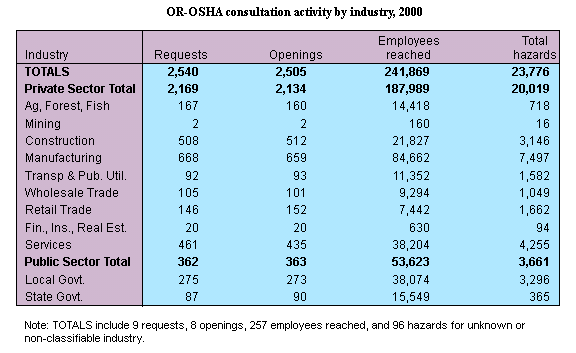
population centers of the state. The consultants opened 2,505 consultations
in calendar year 2000, an increase of 18 percent over the Consultations opened during 2000 reached 241,869 employees. Over 85 percent of openings came at the request of private-sector employers. Manufacturing and construction led all industries in consultations requested and opened. Consultants found 23,776 hazards as a result of 2000 openings, and 12,267 of those were serious, potentially leading to deep cuts, burns, broken bones, etc. OR-OSHA consultative assistance, provided at no cost to the employer, can be an important tool for the small business concerned with reducing the cost of doing business by controlling hazards and, thus, workers’ compensation costs. Small to mid-range employers (100 or fewer employees) accounted for almost 79 percent of consultations opened in 2000.
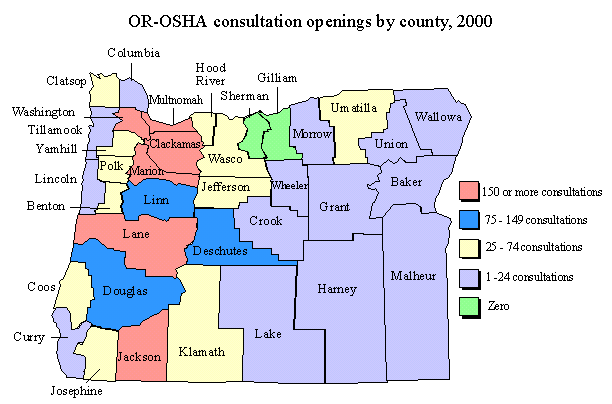
As in previous years, Multnomah County led in the number of consultations opened, at 443, followed by Lane, Marion, and Washington Counties.
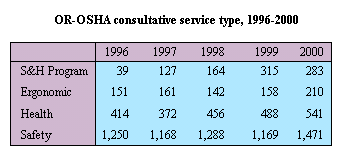
Services provided during 2000 included 1,471 safety, 541 health, and 210 ergonomic consultations. There were 283 consultations on developing prevention plans.
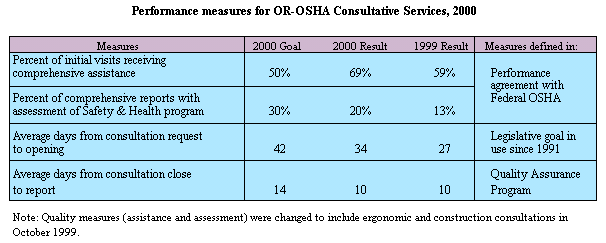
An important part of OR-OSHA’s strategic plan is to change workplace culture to enable more employers to effectively manage safety and health. Consultative Services works with employers to think beyond “OSHA-proofing” or reducing hazards, toward preventing injuries and illnesses. This requires a larger investment of time from consultant and employer in the form of a comprehensive assessment of the workplace, followed by one or more return visits by consultants to develop or improve elements of the employer’s injury and illness prevention program. Comprehensive assistance and assessment (quality), as well as timeliness (efficiency), are among the results-oriented measures for which Consultative Services was accountable under the 2000 Performance Agreement between OR-OSHA and Federal OSHA. The adjoining table shows the results for 2000 compared to the current goals and the previous year’s results. The percent of initial visits where assistance was comprehensive, rather than focused on specific hazards, was above goal at 69%. Twenty percent (20%) of the reports done for comprehensive consultations in 2000 included the 25-element assessment of the employer’s injury and illness prevention program. This percentage is an increase over the 13% in 1999 but still below the strategic plan goal of 30%.
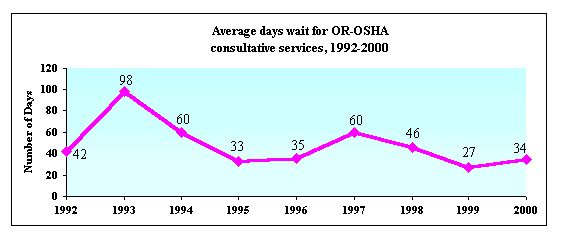
The average lag from employer request to opening of the consultation was 34 days in 2000. This was an increase from the previous year, but was still below the goal of 42 days. An increase in this lag time would be expected with an 18% increase in the number of consultations and no increase in staff. The average wait from consultation closing to mailing of the report of findings was also better than goal, at 10 days.
Increased emphasis on safety and health has played a major role in the reduction of both the number and frequency of work-related claims in Oregon. Leadership provided by OR-OSHA, including the Consultative Services Section, has been prominent. The department’s study, Effectiveness of Oregon OSHA Consultations in Reducing Workplace Hazards (April 1994), found that OR-OSHA consultants noted 1,528 serious hazards at 107 establishments. Subsequent inspections, not connected in any way to the consultations, resulted in citations for 173 alleged serious violations at those same 107 businesses, which indicates that employers reduced hazards by 89 percent. A companion study revealed that the identical 107 worksites saw their accepted disabling injury counts fall about 18 percent in the two years following the consultation, in contrast to their 34 percent increase in injuries in the year prior to the consultation (Effectiveness of Oregon OSHA Consultations in Reducing Disabling Injuries, December 1995). Results from surveys of employers provide additional evidence that the Consultative Services Section continues to be successful in its mission. Statistics from the second quarter of 2001 reveal that 98 percent of employers agreed that the consultant was friendly and knowledgeable; and 97 percent found the services useful toward preventing injuries and illnesses. Eighty-eight percent (88%) of employers had implemented or were in the process of implementing the consultant’s recommendations.
Oregon Occupational Safety and Health
Division’s
To request a no-cost workplace consultation, call the field office closest to you:
|
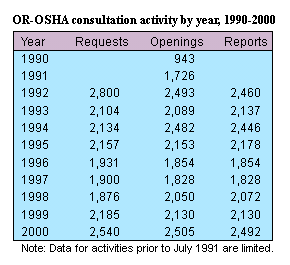 previous year, and mailed 2,492 reports of findings and recommendations
to employers. Because the program is designed to be voluntary, employer
demand drives the workload. In 2000, employers made 2,540 requests for
service, an increase of 16 percent over the previous year. Customer satisfaction
surveys show that previous service is the main reason for consultation
requests, but OR-OSHA referral is the primary means by which employers
learn of the program.
previous year, and mailed 2,492 reports of findings and recommendations
to employers. Because the program is designed to be voluntary, employer
demand drives the workload. In 2000, employers made 2,540 requests for
service, an increase of 16 percent over the previous year. Customer satisfaction
surveys show that previous service is the main reason for consultation
requests, but OR-OSHA referral is the primary means by which employers
learn of the program.