
By Mike Maier
**Note: Click on footnote number to review source
Introduction
The Employer-at-Injury Program (EAIP), created in 1993, is a package of
financial incentives for Oregon employers to encourage the early return
to work of injured workers, while their workers’ compensation claims
are still open.1 The program is one of several
paid out of the Workers’ Benefit Fund, which is financed by the workers’
compensation tax. In 2001, expenditures for EAIP came to about 0.2 cents
per hour worked by each Oregon worker and 0.2 cents per hour from the
employer.
Insurers and self-insurers administer individual early-return-to-work placements (programs) under the EAIP. The Workers’ Compensation Division (WCD) regulates those placements and the conditions for payment of the financial incentives. With the insurer’s assistance, an employer identifies transitional (light-duty or modified) work, obtains a temporary release for work from the injured worker’s medical provider, and then places the injured worker in a job suitable to the worker’s restrictions and limitations. Insurers reimburse employers for costs allowable under administrative rule, such as 50 percent wage subsidies. Practices vary as to when insurers reimburse employers. For instance, SAIF does so upon receipt of a completed wage subsidy request. The department reimburses insurers and self-insurers after the completion of the early-return-to-work program.
Employers’ use of the Employer-at-Injury Program is voluntary. They
may place workers in transitional work without using the EAIP incentives.
As of spring 2001, the department collects data at claim closure  that
may be useful in estimating the total number of transitional-work assignments.
While this report focuses on statistics for placements reimbursed under
the EAIP, Figure 1 shows that over 11,000 workers—nearly half of
claims recently closed—returned to work during the recovery ( time-loss
due and payable) period.
that
may be useful in estimating the total number of transitional-work assignments.
While this report focuses on statistics for placements reimbursed under
the EAIP, Figure 1 shows that over 11,000 workers—nearly half of
claims recently closed—returned to work during the recovery ( time-loss
due and payable) period.
As for the injured worker, Oregon law provides that the insurer or self-insurer may be able to reduce or discontinue time loss benefits if the worker refuses modified work. Effective mid-2001, Senate Bill 485 conferred upon injured workers new rights to refuse modified work. However, an employee who refuses an offer of modified work also risks termination.2 In theory, the EAIP provides an important benefit for the injured worker: a reduction in the uncertainty over the when and where of the return to work. Also, the wage subsidy probably results in a higher wage offer to the worker for the light-duty job.3 Ideally, the transitional-work placement leads to a return to full duty with the employer. The results of recent departmental studies on return to work suggest that the EAIP does indeed promote that outcome, by four to 16 percentage points better than roughly similar groups.4
Characteristics of early-return-to-work placements
The return-to-work assistance available to employers under the EAIP includes
wage subsidies, worksite modifications, and early-return-to-work purchases.
Figure 2 shows that wage subsidies account for most of that assistance. Almost every placement features a wage subsidy, which
is a reimbursement at the rate of 50 percent of the wages paid for the
transitional-work job, for a period of up to three months.
of that assistance. Almost every placement features a wage subsidy, which
is a reimbursement at the rate of 50 percent of the wages paid for the
transitional-work job, for a period of up to three months.
Worksite modifications are designed to allow the injured worker to perform within the limitations of the injury. The maximum reimbursement is $2,500. An example of a worksite modification is an ergonomic chair. These modifications usually become the property of the employer. Purchases are items that are necessary for the job setup regardless of worker disability. The typical purchase is for tools and equipment, to a maximum of $1,000; but work clothing or uniforms up to $400, and tuition, fees, and books up to $750 may also be reimbursed.
Transitional work can take the form of reduced work hours, modified work tasks, a different job or worksite, modified workstations and equipment, and others. The department does not collect data on the kinds of light duty set up under the EAIP. However, relatively few placements under the EAIP include a reimbursement for a worksite modification. Since 1998, the trend for reimbursements for purchases as well as modifications has been a steep decline.
Figure 3 compares counts of early-return-to-work programs to accepted
claims. In 2001, EAIP placements as a percentage of accepted claims increased
somewhat for both types of claim. However, 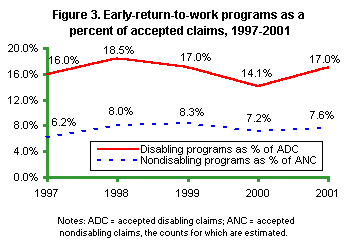 relative
use of the EAIP for disabling (indemnity) claims peaked in 1998, at 18.5
percent of accepted disabling claims. For nondisabling claims, the peak
came in 1999, at 8.3 percent.
relative
use of the EAIP for disabling (indemnity) claims peaked in 1998, at 18.5
percent of accepted disabling claims. For nondisabling claims, the peak
came in 1999, at 8.3 percent.
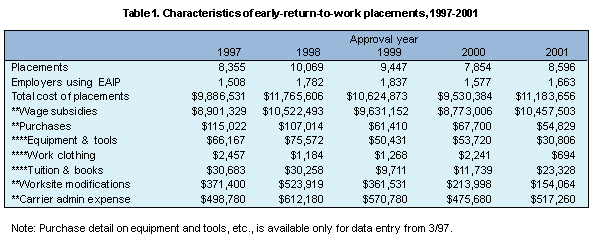
Table 1 shows that the department approved reimbursements for 8,596 early-return-to-work placements in 2001, a 9 percent increase from the previous year. Total reimbursements authorized for the placements came to $11.2 million, up from $9.5 million in 2000, though below the peak of close to $11.8 million in 1998. Early indications from 2002 data are that both placements and reimbursements may be down again in 2002, perhaps due to the changes under Senate Bill 485.
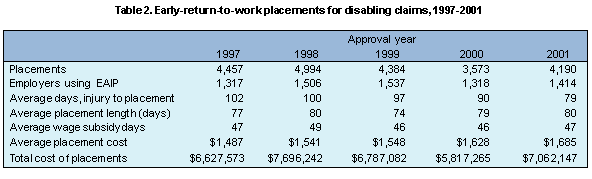
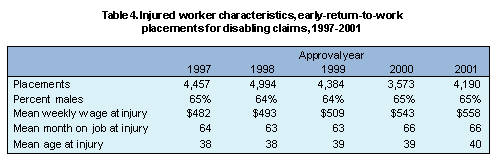
The up-tick in EAIP activity in 2001 was mostly due to a resurgence in reimbursements for disabling claims (see Table 2). The latest year’s figure is 4,190 placements, compared to 3,573 for the previous year and 4,994 in 1998, the peak year. Reimbursements to insurers and self-insurers for placements on disabling claims increased to nearly $7.1 million, compared to $5.8 million in 2000.
The EAIP became available for nondisabling (medical only) claims in 1996. About one-quarter of those claims are serious enough to involve restrictions on job duties, according to departmental analysis.5 Table 3 shows a 3 percent increase in the number of placements for nondisabling claims in 2001 compared to the previous year. Reimbursements increased by about $0.4 million to $4.1 million.
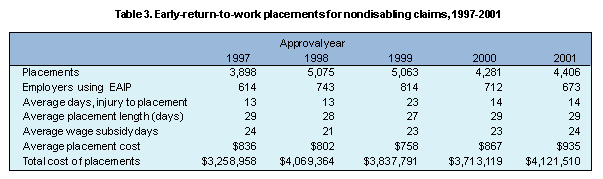
Significantly, about half of the placements for claims classified as nondisabling are made within three days of the injury. Because an accepted claim is likely disabling if it involves more than three days away from work, the EAIP appears be helping employers to avoid thousands of disabling claims by encouraging transitional work, at full wages, soon after injury.
For disabling claims, the average time from injury to placement dropped again in 2001, to 79 days, and the median time (half higher, half lower) was 14 days.6 The average length of these placements was 80 days. The majority of placements for disabling claims include a wage subsidy. Although administrative rules specify that the maximum length of a subsidy is three consecutive months, the rules include safeguards to assure that light duty is not prolonged. The average length of subsidies over the last five years has been around 47 days for disabling claims, and 23 days for nondisabling.
Figure 4 provides a comparison of hourly wage rates for injured workers at the time of the disabling injury and at EAIP placement. The placement hourly rate has been around 95 percent of the injury wage rate. Under Oregon law, any difference in weekly wages earned during the recovery period, whether due to lower hourly wage rates or fewer hours worked, is compensated by temporary partial disability benefits.

Insurers and employers
Workers’ compensation insurers administer individual return-to-work
placements under the EAIP, and for each they receive a $60 flat fee to
cover administrative expenses. Self-insurers also receive this reimbursement.
Reimbursed administrative expenses came close to $525,000 in 2001, about
5 percent of total reimbursements.
Self-insurers, which account historically for around 20 percent of disabling claims, have started roughly one-third of early-return-to-work placements for disabling claims. SAIF generally administers a similar percentage of placements, consistent with its share of disabling claims; but in 2001 SAIF made 39 percent of placements. SAIF insureds spent the most on placements for disabling claims, in total and on average.
Self-insurers have been accounting for roughly 40 percent of both placements started and expenditures for nondisabling claims, but in 2001 their share dropped to about one-third on both measures. SAIF increased expenditures and placements for nondisabling claims in 2001.
Almost 1,700 different Oregon employers used the Employer-at-Injury Program in 2001, around 100 more than in the previous year. However, close to twice as many employers used EAIP for disabling claims as for nondisabling. Over the last five years, employers in the manufacturing industry have been responsible for around 25 percent of EAIP placements for disabling claims and more than one-third of placements on nondisabling claims.
The department estimates that almost half of disabling claims occur at employers of 100 or fewer workers, the small to mid-range firms that make up most of Oregon’s base of employers. Smaller employers started around 45 percent of placements for disabling claims reimbursed in 2001. The department does not routinely collect data on individual accepted nondisabling claims. Some data are collected for EAIP claims. Self-insurers account for a disproportionately large share of EAIP placements for nondisabling claims. Since most self-insurers are large businesses, it should not be surprising that larger employers start at least two-thirds of placements for nondisabling claims. Since the beginning of the EAIP in 1993, a handful of large employers have made at least 1,000 placements.
Undoubtedly, many smaller employers have difficulty identifying suitable transitional work. Creation of light-duty jobs may be relatively difficult for certain lines of business, such as construction, as well. Senate Bill 485 of 2001 gives injured workers new rights to refuse some modified work arrangements, including alternative worksites.
Injured workers
Table 4 presents demographics for injured workers with disabling claims
who were placed into transitional work under the Employer-at-Injury Program.
The percentage of females and the average weekly wage at injury have been
higher for EAIP participants, compared to all workers with a disabling
claim. Average tenure has been around 25% higher for the early-return-to-work
group. Figures for average age at injury are similar to those for all
workers with a disabling claim.
Possibly, differences in demographics between EAIP participants and all workers with a disabling claim are due to employer selectivity over which workers are the best candidates for early return to work. Interestingly, there is little apparent difference in distributions of workers by occupation group. For instance, more than 40 percent of disabled workers placed in light duty under EAIP were working in operator, fabricator, and laborer occupations, and the same holds true for all workers with a disabling claim. Analysis at a more detailed level of classification likely would find differences, if only because the occupational mix varies by industry, and employers in certain industries are more likely to use the EAIP.
 The
kinds of injury affecting disabled workers with EAIP placements show little
difference, at first glance, from those for all workers with accepted
disabling claims. There is other evidence, however, that employers select
the more severely injured workers. For disabling claims closed in 2000,
around 32 percent of claims with EAIP assistance had an award for permanent
partial disability (PPD), compared to a 23 percent PPD rate for other
claim closures. Similar disparities in PPD rates exist back through 1995
closures (see Figure 5). Average costs for medical services, reported
at closure, have been higher for claims featuring an EAIP placement, also.
7
The
kinds of injury affecting disabled workers with EAIP placements show little
difference, at first glance, from those for all workers with accepted
disabling claims. There is other evidence, however, that employers select
the more severely injured workers. For disabling claims closed in 2000,
around 32 percent of claims with EAIP assistance had an award for permanent
partial disability (PPD), compared to a 23 percent PPD rate for other
claim closures. Similar disparities in PPD rates exist back through 1995
closures (see Figure 5). Average costs for medical services, reported
at closure, have been higher for claims featuring an EAIP placement, also.
7
Disability as measured by Preferred Worker identification is more prevalent among workers placed in light duty under the Employer-at-Injury Program. Preferred Workers have a permanent disability that prevents return to regular work. Nearly 12 percent of EAIP claims closed in 2000 resulted in identification as a Preferred Worker, compared to 8 percent of other closures.
Outcomes
The Employer-at-Injury Program probably saves employers money on workers’
compensation premiums. Wages paid for the transitional work largely replace
time loss (temporary disability) payments, and reimbursements for wage
subsidies are not included in calculations of insurance premium costs.
The department estimates that use of around $7.3 million in wage subsidies
under the Employer-at-Injury Program—half of which is funded by worker
assessments—resulted in $10.8 million in savings on time loss for
claims closed in 2000. These savings represent 1.7 percent of 2000 loss
(benefit) costs. Note that this estimate of savings does not include other
claim costs, such as permanent partial disability and vocational assistance,
or indirect costs such as lost productivity, that may be avoided by use
of the EAIP.
Early return to work under the EAIP centers on return to a restricted-duty
job within the limitations of the workplace injury or illness. From the
standpoint of the injured worker, a good measure of the Employer- at-Injury
Program’s success is job retention following the placement. The department
monitors employment of injured workers by conducting occasional studies
using wage data from the Oregon Employment Department. Figure 6 displays
results of the latest study, for workers with disabling injuries or illnesses
during 1997, several years after the inception of the EAIP. As of May
2002, the study did not include final results for nondisabling claims.
8
at-Injury
Program’s success is job retention following the placement. The department
monitors employment of injured workers by conducting occasional studies
using wage data from the Oregon Employment Department. Figure 6 displays
results of the latest study, for workers with disabling injuries or illnesses
during 1997, several years after the inception of the EAIP. As of May
2002, the study did not include final results for nondisabling claims.
8
The study’s definition of the EAIP group was injured workers with accepted disabling claims whose participation in the Employer-at-Injury Program was the only form of reemployment assistance they received. In other words, the EAIP group included only workers who were determined ready to return to work at claim closure, after the EAIP placement. As noted above, there is a small but significant percentage of EAIP placements who can’t return to their regular jobs, and those workers were not included in the EAIP group. All injured workers in the EAIP group were eligible to receive temporary disability benefits, and many were awarded benefits for permanent disability. The natural comparison groups, then, are other injured workers receiving no reemployment assistance after claim closure. These workers were categorized according to whether their disabilities were rated as permanent (PPD, or permanent partial disability) or not (TD, temporary disability only). By most measures, workers in the EAIP group had injuries more severe than workers in the TD group, but less so than workers in the PPD group.
Roughly one year after injury, 68 percent of the EAIP group was still employed by the employer at injury, compared to 64 percent for the PPD group and only 52 percent for the TD group. In the short-term, then, workers placed into transitional duty under the EAIP apparently experienced the least amount of disruption from their pre-injury employment. In the long run, as measured 13 quarters after injury, workers in the EAIP group also showed the strongest employment rate, at 77 percent, compared to 72 percent for the PPD group and 68 percent for TD.
Footnotes
1 Throughout
this report, forms of the word “injury” connote occupational
disease as well as injury.
2 See ORS 656.268(4)(c)
and 656.325(5), which are general, rather than EAIP, statues. For a discussion
of light duty from the perspective of both the employer and the worker,
see Ed Welch, “Alternative Return to Work,” in On Workers’
Compensation (May 2000).
3 See Workers’ Compensation
Research Institute: What are the Most Important Factors Shaping Return
to Work? (1996). Also, administrative rules were revised in 1997 to
encourage higher wage offers.
4 Comparison is made among
workers able to return to regular work at the time of claim closure. See
Outcomes.
5 This statistic is derived
from results of the Oregon Occupational Injury and Illness Survey applied
to departmental estimates of the number of accepted nondisabling claims.
6 Use of EAIP placements
for claim reopenings affects the mean more than the median.
7 Administrative rule
gives employers and insurers more than a year to report placements. Thus,
closure year 2000 was the most recent year for which EAIP placement data
were fully available in May 2002. ”Other closures” include claims
with disability severe enough to warrant eligibility for retraining, as
well as the large majority of claims with no permanent disability.
8 See Employment Patterns
for Workers with Accepted Disabling Claims, Accident Year 1997, Oregon
Workers’ Compensation System (April 2002) http://www.cbs.state.or.us/external/imd/rasums/resalert/ep97.htm
DCBS Public Home Page | DCBS
Site Search | IMD
Search |IMD Home
Page
If you have questions, about the information contained in this document please contact by e-mail or phone: Mike Maier, Research Analyst, Research & Analysis Section, Information Management Division (503) 947-7352
This web page was last revised: 06/13/02.
In compliance with the Americans with Disabilities Act (ADA), all IMD publications are available in alternative formats by calling (503) 378-4100 (V/TTY). The information in IMD publications is in the public domain and may be reprinted without permission.
[Printed form 440-3123 (06/02/IMD)]