
by Gary Helmer
Introduction
The legislature states in the Oregon Revised Statutes (ORS) 656.012(2)(c)
that one objective of the workers’ compensation law is:
To restore the injured worker physically and economically to a self-sufficient status in an expeditious manner and to the greatest extent practicable.
Many injured workers need vocational assistance, such as training and job-search assistance, to accomplish this objective (see ORS 656.340 and Oregon Administrative Rules (OAR) 436-120). Workers are eligible for vocational assistance if they are unable to return to their previous job or other suitable, available work with the same employer and if they have a substantial handicap to employment. Insurers determine injured workers’ eligibility for vocational assistance. Insurers and workers jointly select vocational assistance providers. Information about the program are provided in the department’s publication Vocational Assistance in the Oregon Workers’ Compensation System.
This executive summary provides information about the disputes arising from the vocational assistance program. The Rehabilitation Review Unit (RRU) of the Department of Consumer and Business Services Workers’ Compensation Division (WCD) resolves these disputes. The dispute process is defined in ORS 656.283(2):
(2)(a) The Legislative Assembly finds that vocational rehabilitation of injured workers requires a high degree of cooperation between all of the participants in the vocational assistance process. Based on this finding, the Legislative Assembly concludes that disputes regarding eligibility for and extent of vocational assistance services should be resolved through nonadversarial procedures to the greatest extent possible consistent with constitutional principles. The director is hereby charged with the duty of creating a procedure for resolving vocational assistance disputes....
(b) If a worker is dissatisfied with an action of the insurer or self-insured employer regarding vocational assistance, the worker must apply to the director for administrative review of the matter. Such application must be made not later than the 60th day after the date the worker was notified of the action. The director shall complete the review within a reasonable time. If the worker’s dissatisfaction is resolved by agreement of the parties, the agreement shall be reduced to writing, and the director and the parties shall review the agreement and either approve or disapprove it. If the worker’s dissatisfaction is not resolved by agreement of the parties, the director shall resolve the matter in a written order containing findings of fact and conclusions of law....
Resolution requests and disputed issues
There were 512 requests for the resolution of vocational assistance disputes
in 2001 (see Table 1). The number of requests has fallen 75 percent since
1991. This is chiefly because insurers and self-insured employers have
made 70 percent fewer vocational assistance eligibility determinations.
There has also been a small decline in the percentage of vocational assistance
cases with a dispute. In 2001, 19 percent of the claims for which vocational
assistance determinations were made had a vocational dispute.
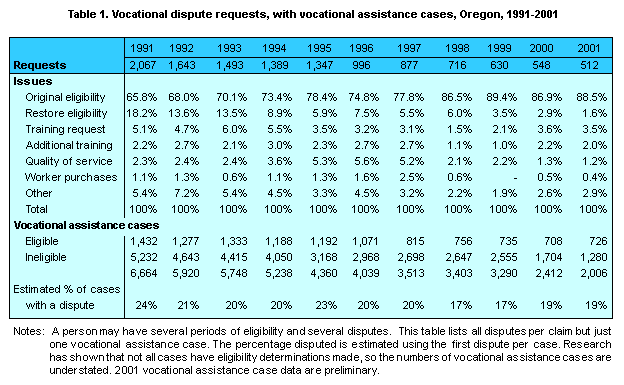
In 2001, the issue in 88 percent of the disputes was claimants’ original eligibility for vocational assistance. Insurers can terminate workers’ eligibility when they receive information that affects workers’ eligibility status. Disputes about the ending of eligibility caused 2 percent of the disputes.
Vocational benefits fall into three main categories: professional services provided by private rehabilitation organizations; timeloss payments to claimants who are in authorized training programs; and direct purchases, such as tuition and books, tools required for training programs, and work clothing. Professional services include vocational evaluation and the development of training plans and direct employment plans. In 2001, 7 percent of the disputes were about eligibility for training programs, the continuation of training programs, the quality of the professional services offered, or worker purchases.
Dispute resolutions
Vocational assistance disputes are resolved in three ways: through agreements,
by dismissals, and through orders. When the disputing parties agree to
a resolution, RRU issues an agreement letter. In 2001, 33 percent of the
resolutions consisted of agreement letters (see Table 2). This is the
highest percentage since 1995 and reflects growing success in the goal
of gaining cooperation among the parties.
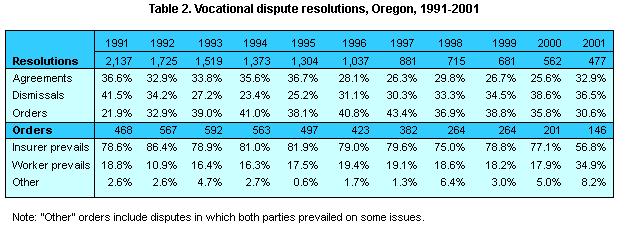
Thirty-six percent of the disputes were dismissed. Disputes may be dismissed for several reasons. The most common occurrence is the agreement to a Claim Disposition Agreement. A CDA is an agreement in which the worker gives up future non-medical benefits, usually including vocational assistance, for a cash settlement. In 2001, 15 percent of the resolutions were dismissals because of CDAs. Other disputes were dismissed when the worker requested the withdrawal of the review or failed to provide the needed information. RRU also dismissed untimely disputes.
RRU resolved 31 percent of the 2001 disputes through Director’s Review and Orders (orders). RRU issued 146 orders, down 27 percent from 2000. Most orders resolve the dispute in favor of either the insurer or the worker, although there are a few cases in which both parties prevail on some issues. In 2001, insurers prevailed in 57 percent of the disputes in which RRU issued orders. This is a drop from 77 percent in 2000. This change may be due to a revision of OAR 436-120 that clarified when vocational assistance determinations were needed. This may have led to fewer disputes from workers in cases in which they were clearly not eligible for vocational assistance.
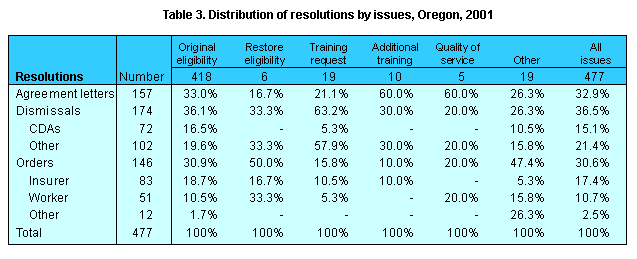
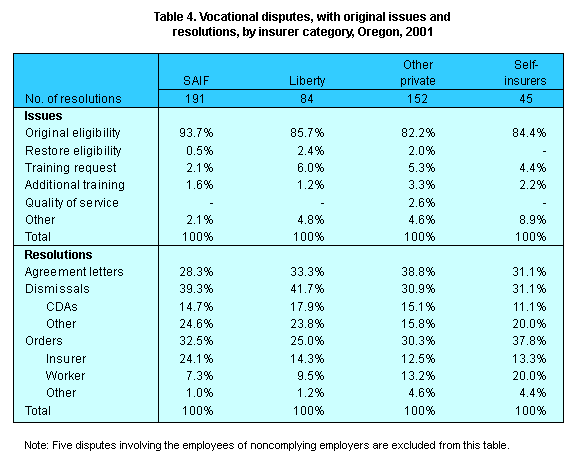
Different types of disputes have different types of resolution (see Table 3 and Table 4). Eligibility disputes are the most common type of dispute to be resolved through orders. In 2001, 31 percent of the original eligibility disputes were resolved through orders. In contrast, 16 percent of the training requests were resolved through orders; the majority were dismissed.
Dispute processing
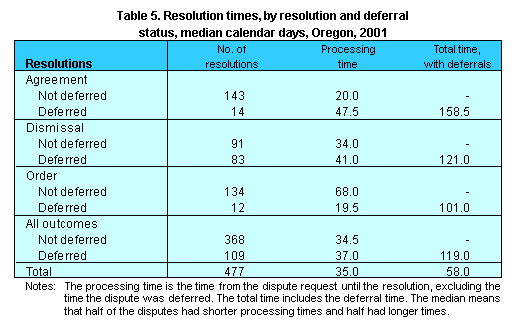
In 2001, RRU processed vocational disputes in an average of 35 days (see
Table 5). The processing times vary, however, depending on the availability
of information and the parties’ plans. Twenty-three percent of the
disputes were deferred at some point in the resolution process. Disputes
are deferred while the parties negotiate CDAs, when necessary information
is not available for a prolonged period of time, such as medical information
or the results of hearings, or when the worker is unable to participate
in the dispute process for a time. This deferral time can be quite long.
For the disputes that were not deferred, the median time for resolution
was 35 days; for disputes that were deferred, the median time from request
to resolution was 119 days.
Appeals of vocational dispute orders
RRU’s vocational dispute orders may be appealed as Contested Case
Hearings (CCH). The appeal must be made within 60 days of the order. In
general, only orders are appealed. On occasion, however, workers appeal
dismissals that were made for reasons other than a CDA. The original decision
can be modified only if it violates a statute or rule, exceeds the agency’s
authority, was based on an unlawful procedure, or was characterized by
the abuse of discretion or clearly unwarranted exercise of discretion.
Thirty-one percent of the orders RRU issued in 2001 were appealed. This compares to a 20 percent appeal rate in 2000. This jump in the appeal rate is due in part to the increased percentage of orders that favored workers. Of RRU’s orders in which insurers prevailed, 26 percent were appealed; of the orders in which workers prevailed, 57 percent were appealed.
As of the time of this report, many appealed 2001 orders were still pending. Most 2000 appeals, however, had been resolved. Of the 38 decisions for 2000 appealed orders, 26 appeals were withdrawn or dismissed. Of the remaining 12 appeals, 6 CCH orders affirmed RRU’s orders and 4 CCH orders reversed RRU’s orders; there was also 1 partial affirmation and 1 stipulation.
If you have questions, about the information contained in this document please contact by e-mail or phone: Gary Helmer, Research Analyst, Research & Analysis Section, Information Management Division (503) 947-7325
This web page was last revised: 02/08/02.
In compliance with the Americans with Disabilities Act (ADA), all IMD publications are available in alternative formats by calling (503) 378-4100 (V/TTY). The information in IMD publications is in the public domain and may be reprinted without permission.