Mortgage
Lender Pilot Project Survey Findings
Introduction and Purpose of Survey
A growing number of states have recently began to make services available over the Internet which were once submitted by mail and processed by state employees. E-government, or the availability of electronic government services to business and citizens, stems from the astronomical growth of private sector e-commerce. Like e-businesses, states are trying to increase their productivity and access to consumers by electronically automating their services. Registering to vote, filing taxes, personnel information searches, and professional licensing are species of e-government already used in many states. In Oregon the Department of Consumer and Business Services is considering putting online one of the services it offers, the licensing of mortgage lenders. As a part of this initiative, the Research and Analysis Section completed a survey of mortgage lenders to determine the number who might use such a service.
There are five main findings of the survey…
- 82 percent of the lenders said they would use online licensing.
- 82 percent also said they would have used online licensing to obtain their original license had it been available at the time.
- 45 percent of the lenders said they would renew online if the procedure required the transmission of sensitive confidential company information.
- 96 percent said they would renew online if the procedure didn't involve the transmission of confidential company information.
- 51 percent had visited the Financial Institutions website.
Of the 99 surveys sent out, 55 were returned making a response rate of 56 percent. Some 82 percent of the lenders said they would use the online service to renew their mortgage lender license. Another 16 percent said they would mail in the application, while 2 percent didn't prefer one method to another. Oregon's 82 percent is a significantly higher proportion than surveys in other states have found. A survey done by the University of Texas, for instance, found that about 60 percent of individuals seeking professional licensing would use an online service. The actual experience of states so far in response to online licensing is highly variable however. Arkansas reports that 10 percent of those in state seeking renewal of professional licenses actually used the online version. Georgia also reports a usage of online licensing between 10 percent and 40 percent depending on the occupation. Maryland however said that over 50 percent of those seeking licenses used the online service, and for some occupations it was over 80 percent of licensees. Thus 82 percent of mortgage lenders is high according to the experiences of other states but not unrealistic.
Eighty-two percent also said they would have used the online
service to obtain their original license had it been available
at the time. This is an important question because typically
getting the original license is more complicated than renewing.
For mortgage lenders, both involve
submitting confidential financial statements and review of past
business practice and other states experiences in regulating
the firm. Renewing a license is still a time consuming and complicated
process thus it is not surprising the same percentage say they
would have used an online procedure had it been in existence.
The actual number of responses to each question are given in Table 1 below…
|
|
||
|
|
|
(out of 55) |
| 1. Would you use the Internet to renew your mortgage lender license or would you prefer to use the traditional licensing procedure? |
Use Online Licensing Stay with the traditional procedure Either is Acceptable |
9 1 |
| 2. If the online service had been available at the time you originally were licensed, would you have used it then? |
Yes No Not Sure |
9 1 |
| 3. Would you be reluctant to use the online service if it required the transmittal of confidential company information over the Internet? |
Yes No |
25 |
| 4. Would you use the online service if there was no submitting of confidential information required and documents such as financial statements were sent through the mail instead? |
Yes No |
2 |
| 5. What other concerns about online licensing might you have that would prevent you from using the service? |
No difference in application processing time Takes too much time to learn Internet too expensive or inaccessible Others… |
2 2 6 |
| 6. Have you visited the Financial Institutions website? |
Yes No |
27 |
| 7. If so, how useful has that information been to you? |
Very Somewhat Not at all |
14 0 |
| 8. How could we improve our website to provide assistance to you? | A list of frequently asked questions would be helpful, more common sense word usage, forms that are downloadable… | |
The responses to the survey also show what kind of service the
lenders would prefer. They would prefer to fill out the application
online and mail in the income statements, and other sensitive
financial statements that reveal confidential company information.
A whopping 96 percent said they would use the service if there
was no submitting of confidential information, and 55 percent
said they would be reluctant to use the service if it required
confidential documentation. Thus the percentage who would use
the service to renew drops to forty-five. The mortgage lenders
are obviously highly concerned with security and confidentiality.
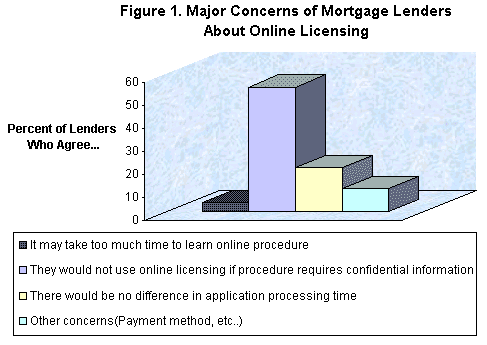
Among the other concerns cited by the lenders are that there would be no difference in application processing time and online licensing would take too much time to learn. Some 16 percent felt there may be no difference in application processing time while 4 percent had the latter concern. Figure 1 shows the concerns of lenders about online licensing. Another concern voiced related to method of payment. If the service involves payment by credit card this will exclude a small minority of firms who don't have company credit accounts. Finally two percent were concerned with the reliability of the service. The primary concerns were thus submitting confidential documentation and the impression that there may be no difference in processing time of the application. It is important to note that this question was focused on identifying possible obstacles presented by the online process, not the reasons why that lender would not use the service.
Figure 1 shows the concerns of lenders about online licensing.
Finally the survey asked the lenders if they had ever visited
the Financial Institutions website. Almost 51 percent said they
had, with all saying the site was very useful or somewhat useful
in their search for information. This is an important question
because if few are aware of the service naturally the percentage
renewing their license online will be much smaller than the survey
results suggest. Indeed this may explain the experience of some
states like Arkansas, who saw such a poor response rate to their
e-government effort. Georgia also told us they expect their usage
rate to increase this year, as more customers become aware of
the online procedure. It will be important to let all lenders
know when the service is online, and precisely how it works.
The lenders also had comments and suggestions on how to improve
the website. One person suggested adding a list of frequently
asked questions on common licensing problems. Another thought
there could be more common sense word usage and better explanation
of the licensing guidelines. But most said they found the website
helpful and easy to use.
The survey is designed to be a random sample of working mortgage lenders. The survey participants were chosen at random from a large database of presently licensed lenders. As a consequence, the distribution of survey participants with regard to rural location and state of residence matches closely the distribution for these factors in the whole database. Close to fifty percent of the survey participants reside out of state, which is nearly the percentage found in the lender database. The survey is also designed to be statistically significant, in that we sought and received enough responses to construct a 95 percent confidence interval of the true population proportion favoring online licensing with a sampling error of plus or minus 10 percent. A draft of the survey was pre-tested on a small group of lenders, whose job it was to suggest changes and questions that would make the survey more user friendly and appropriate for that group. The survey consists of eight questions, with six having to do with attitudes and preferences regarding online licensing and two evaluating usage and opinion of the Financial Institutions website.
The salient feature of the survey is that a significant majority or 82 percent of the lenders said they would choose an online format to renew their mortgage license. 82 percent also said they would have chosen online licensing the first time to obtain their original license. From January 1999 to January of 2000, 588 licenses were issued. If just 70 percent of lenders chose to renew online that would mean about 412 would use the new service. (This assumes that all who were renewing their license were aware of the online format).
The second important result of the survey is that the participants were very clear about exactly what the process should look like. Online licensing should involve filling out the application online and mailing in the required supporting documentation. There would be a significant drop in participation if the procedure required the lenders to submit confidential financial statements on the World Wide Web.
Finally 51 percent of the lenders stated they had visited the Financial Institutions website, with half of those saying the information they obtained was very useful and 50 percent saying it was somewhat useful.
DCBS Public
Home Page | DCBS
Site Search | IMD
Search |IMD
Home Page
If you have questions, about the information contained in this document please contact by e-mail or phone: Clifton.Hindmarsh, Research Analyst, Research & Analysis Section, Information Management Division (503) 947-7053
This web page was last revised: 11/15/00.